
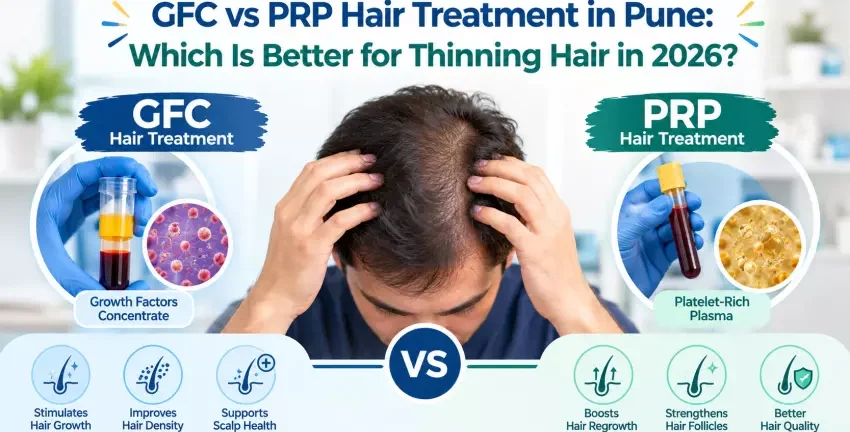
GFC vs PRP Hair Treatment: Key Differences
Thinning hair, a widening parting, or a receding hairline can affect both confidence and everyday life. If you are exploring GFC vs PRP Hair Treatment in Pune, understanding how these therapies work can help you make a more informed decision about hair restoration.
Growth Factor Concentrate (GFC) and Platelet-Rich Plasma (PRP) are regenerative treatments that use components derived from your own blood. Both aim to support hair growth in suitable candidates, but they differ in preparation methods and treatment protocols.
In this guide, Dr. Ruchi Bhirud explains the differences between GFC and PRP, their potential benefits and limitations, and the factors to consider before choosing a hair thinning treatment in Pune.
Neither treatment is suitable for every type of hair loss. The most appropriate option depends on the diagnosis, scalp condition, hair-loss pattern, and individual treatment goals.
What Is GFC Hair Treatment?
GFC hair treatment in Pune is a regenerative hair restoration procedure that uses growth factors derived from a patient’s own blood. These biological signalling molecules play an important role in tissue repair and cellular activity and may help support hair follicle function.
How Does GFC Work?
During GFC hair treatment, a healthcare professional collects a blood sample and processes it using a specialised preparation system. The resulting concentrate is then administered into selected areas of the scalp.
The aim is to provide growth factors that may support follicular activity and improve hair-related outcomes in appropriate candidates. However, GFC cannot guarantee that inactive or permanently destroyed hair follicles will produce new hair.
Who May Consider GFC?
A dermatologist may consider GFC for people experiencing certain forms of pattern hair loss or early hair thinning, depending on the clinical assessment.
It is important to identify the cause of hair loss first. Sudden shedding, nutritional deficiencies, thyroid disorders, scalp inflammation, and other medical conditions may require different management. Learn more about GFC Hair Treatment in Pune.
What Is PRP Hair Treatment?
PRP hair treatment in Pune is a regenerative hair treatment that uses a concentrated portion of the patient’s own blood, known as Platelet-Rich Plasma (PRP). The platelets release growth factors and other signalling molecules that play an important role in normal biological processes and may help support hair follicle activity.
How Does PRP Work?
A blood sample is collected and processed using a centrifuge to separate platelet-rich plasma. The prepared plasma is then injected into selected scalp areas according to the treatment plan.
Research suggests that PRP may improve hair density in some people with androgenetic alopecia, also known as pattern hair loss. However, results vary, and differences in preparation methods and treatment protocols make it difficult to predict individual outcomes. A systematic review published in 2024 found evidence supporting the potential of PRP for androgenetic alopecia, while also noting limitations in the available research.
Read the research: PRP for Androgenetic Alopecia — Systematic Review.
Who May Consider PRP?
PRP may be considered for selected patients with pattern hair loss after a dermatologist evaluates their scalp and medical history. It should not automatically replace established medical treatments when these are indicated. Explore PRP Hair Treatment in Pune for more information.
GFC vs PRP: Which Works Better for Thinning Hair?
The answer depends on the individual rather than the treatment name alone. Both GFC and PRP have shown potential in managing selected forms of hair loss. Some comparative studies report favourable outcomes with GFC, but differences in study design, sample size, preparation techniques, and follow-up periods limit firm conclusions.
Hair Density and Thickness:
Both therapies aim to support hair growth and may improve hair density or thickness in suitable patients. The extent of improvement depends on the type and severity of hair loss, the condition of existing follicles, and other individual factors. Neither treatment guarantees complete restoration of the original hairline or density.
Comfort and Recovery:
Both procedures involve injections into the scalp. Temporary discomfort, tenderness, redness, swelling, or small bruises may occur. The level of discomfort can vary according to the injection technique, preparation method, and individual sensitivity. It would be inaccurate to claim that GFC is always painless or that PRP necessarily causes more inflammation.
Number of Sessions:
The recommended number of sessions differs according to the patient's diagnosis, the selected protocol, and the response to treatment. Some treatment plans use sessions spaced several weeks apart, followed by reassessment. A fixed number of sessions should not be promised to every patient.
Cost Considerations:
GFC and PRP treatment costs vary depending on the preparation system, equipment, clinician's assessment, number of sessions, and follow-up requirements. Rather than choosing solely on price, patients should understand what each treatment includes and whether it is appropriate for their condition.
How to Choose the Right Hair Loss Treatment in Pune?
Before choosing between GFC and PRP, it is important to understand why your hair is thinning.
1. Get the Correct Diagnosis:
Hair loss can occur because of hereditary pattern hair loss, temporary shedding, nutritional deficiencies, hormonal conditions, scalp disorders, or certain medications. A dermatologist may examine the scalp, assess the pattern of thinning, review your medical history, and recommend blood tests when clinically indicated.
2. Discuss Expected Results:
Ask about the likely benefits, limitations, possible side effects, treatment schedule, and maintenance requirements. Progress should be assessed over an appropriate period using consistent photographs or other clinical measures.
3. Consider Other Treatment Options:
GFC and PRP are not the only approaches to hair loss. Depending on the diagnosis, evidence-based medical treatments and correction of underlying causes may be more important. A personalized treatment plan may involve more than one approach. Any combination should be recommended by a qualified clinician after assessing the individual patient.
Are GFC and PRP Hair Treatments Safe?
Because both treatments use material derived from the patient’s own blood, they avoid some concerns associated with introducing unrelated donor material. However, using autologous blood does not make a procedure entirely risk-free.
Potential complications include pain, bruising, temporary swelling, infection, and reactions related to the procedure or preparation process. Appropriate sterile technique, suitable patient selection, and trained medical supervision are important.
Patients should disclose relevant medical conditions, medicines, bleeding disorders, and scalp problems before treatment. People with sudden, patchy, painful, or rapidly progressing hair loss should seek medical assessment rather than proceeding directly to a regenerative procedure.
Frequently Asked Questions:
👉 Is GFC better than PRP for hair loss?
Not conclusively. Some studies report favourable outcomes with GFC, but current comparative evidence is limited. The appropriate choice depends on the diagnosis, individual needs, and treatment protocol.
👉 How long does it take to see results?
Hair growth is a gradual process. Any improvement may take several months to assess, and the timing varies between individuals. Results cannot be guaranteed within a specific number of weeks.
👉 Can GFC or PRP regrow hair on a completely bald scalp?
Neither treatment can reliably restore hair where follicles have been permanently destroyed. A dermatologist should assess the scalp and discuss realistic options.
👉 Are GFC and PRP permanent hair-loss solutions?
They should not be considered guaranteed permanent solutions. Some patients may require ongoing management, and the underlying cause of hair loss may continue to progress.
👉 Where can I consult a dermatologist for GFC or PRP in Pune?
Dr. Ruchi Bhirud (Jawale) provides dermatology and hair-treatment consultations in Pashan, Pune. An individual assessment can help determine whether GFC, PRP, another treatment, or a combination is appropriate.
Conclusion:
Choosing between GFC vs PRP Hair Treatment in Pune starts with understanding the cause of your hair loss. Both therapies may benefit selected patients, but neither is universally superior, and individual outcomes vary.
A dermatologist can help you compare the available options, understand their limitations, and develop a treatment plan based on your scalp condition and goals.
For a consultation with Dr. Ruchi Bhirud, visit Dr. Ruchi Bhirud’s website or call +91 9766970697.