
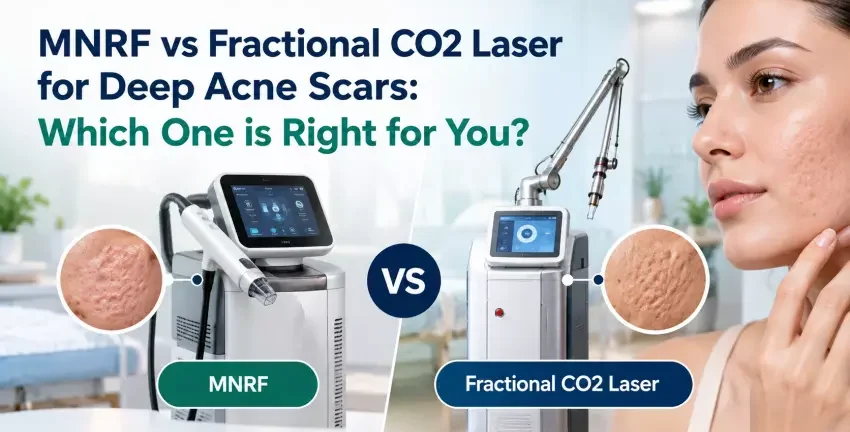
Quick Answer: When evaluating MNRF vs fractional CO2 laser for deep acne scars, MNRF (Microneedling Radiofrequency) uses insulated gold-tipped needles and thermal energy to remodel deeper dermal collagen with minimal downtime, making it ideal for rolling and boxcar scars. Conversely, fractional CO2 laser is an ablative resurfacing tool that removes microscopic columns of skin surface to treat severe texture irregularities, though it requires a longer healing period. Choosing the optimal MNRF vs fractional CO2 laser for deep acne scars depends on individual scar depth, skin tone, and lifestyle tolerance.
Understanding the Challenge of Deep Acne Scars:
Persistent acne breakouts often leave behind stubborn marks and pitted textural changes that alter smooth skin architecture. For individuals researching solutions, comparing MNRF vs fractional CO2 laser for deep acne scars is the crucial first step toward achieving lasting skin renewal.
Addressing severe atrophic scarring requires precise energy delivery to stimulate new collagen and elastin production. Patients seeking professional guidance often explore Advanced Acne Scar Reduction Treatments and schedule Medical Dermatology Consultations to evaluate their unique skin type. Dr. Ruchi Bhirud provides expert clinical assessments to determine whether MNRF vs fractional CO2 laser for deep acne scars will deliver the safest and most effective transformation.
What is MNRF (Microneedling Radiofrequency)?
Microneedling Radiofrequency is an advanced, minimally invasive technology designed to target deep dermal layers without severely damaging the outer epidermis.
- How MNRF Works: Fine, micro-needles penetrate the skin to precise depths, releasing high-intensity radiofrequency energy directly into the dermis. This dual action of mechanical micro-injury and thermal heating triggers powerful microneedling radiofrequency dermal remodeling.
- Key Benefits: Excellent for tightening skin, shrinking enlarged pores, and softening rolling or deep boxcar scars.
Many patients turn to a dedicated Microneedling Radiofrequency Clinic experience to achieve smooth texture improvement with faster recovery times compared to traditional ablative lasers. Furthermore, selecting MNRF treatment for deep acne scars offers a reliable path for individuals who want effective results without extended time away from daily routines.
What is Fractional CO2 Laser?
Fractional CO2 laser is a gold-standard ablative resurfacing treatment that targets both the superficial epidermis and deeper dermal layers.
- How Fractional CO2 Laser Works: The laser beam is fractionated into thousands of microscopic treatment zones, vaporizing columns of damaged skin tissue while leaving surrounding tissue intact to accelerate healing.
- Surface Resurfacing vs. Deep Ablation: This powerful ablative skin resurfacing laser physically removes outer scarred layers while stimulating deep collagen production, making it highly effective for stubborn icepick and deep boxcar scars.
Utilizing specialized Fractional Laser Resurfacing Services under professional supervision ensures safe energy calibration. When evaluating MNRF vs fractional CO2 laser for deep acne scars, understanding that fractional CO2 provides deeper surface peeling is essential for setting realistic recovery expectations.
Head-to-Head Comparison: MNRF vs. Fractional CO2 Laser
Comparing MNRF vs fractional CO2 laser for deep acne scars involves analyzing penetration depth, downtime, and safety profiles across different skin types.
Depth of Penetration and Scar Types Targeted:
- MNRF: Delivers adjustable thermal energy deep into the dermis (up to 3.5 mm) while protecting the skin surface. It is exceptionally effective for rolling scars, laxity, and open pores.
- Fractional CO2 Laser: Penetrates deeply through micro-ablative columns, excelling at flattening sharp-edged boxcar scars and deep icepick scars.
Downtime, Healing, and Side Effects:
- MNRF Recovery: Typically involves mild redness and swelling for 24 to 48 hours, allowing patients to resume normal activities quickly.
- Fractional CO2 Laser Recovery: Requires a fractional CO2 laser for acne scars recovery period lasting 5 to 10 days, characterized by peeling, scabbing, and pinkness. Reviewing the downtime and side effects of MNRF vs CO2 laser helps patients plan their schedules accordingly.
Suitability for Indian Skin Tones and Pigmentation Risks:
A major factor when deciding MNRF vs fractional CO2 laser for deep acne scars is the risk of post-inflammatory hyperpigmentation (PIH). MNRF delivers thermal energy beneath the skin surface, significantly lowering post-inflammatory hyperpigmentation risks in melanin-rich skin tones. Fractional CO2 laser requires strict sun protection and expert parameter settings to prevent pigmentation changes.
Side-by-Side Comparison Table:
Combining Technologies for Optimal Results:
In many complex cases, severe acne scarring does not respond to a single modality. Dermatologists often combine therapies to address multi-layered skin damage. For example, a patient might undergo initial sessions of MNRF vs fractional CO2 laser for deep acne scars combined alternately with Chemical Peels and Skin Rejuvenation or targeted Pigmentation and Laser Care.
Integrating Anti-Aging and Skin Tightening Solutions ensures that both textural smoothness and youthful elasticity are restored concurrently under the expert guidance of Dr. Ruchi Bhirud.
Conclusion:
Overcoming deep acne scars requires a strategic, scientifically backed approach tailored to your unique skin architecture. Whether selecting microneedling radiofrequency or ablative laser resurfacing, expert medical guidance makes all the difference in achieving smooth, radiant skin. To explore personalized options for MNRF vs fractional CO2 laser for deep acne scars, consult Dr. Ruchi Bhirud for advanced, tailored care.
FAQs:
👉 What is the main difference between MNRF and fractional CO2 laser for deep acne scars?
The core difference lies in how energy is delivered. MNRF uses insulated micro-needles to heat the deep dermis while leaving the top skin layer intact, whereas fractional CO2 laser vaporizes microscopic columns of surface skin tissue. Dr. Ruchi Bhirud assesses individual scar depths to recommend the right option.
👉 Which treatment has a shorter downtime: MNRF or fractional CO2 laser?
MNRF has a much shorter downtime, usually involving just 24 to 48 hours of mild redness. In contrast, fractional CO2 laser requires a 5-to-10-day recovery window due to surface peeling and healing. Dr. Ruchi Bhirud helps patients select a treatment that fits their lifestyle and schedule.
👉 Is MNRF safer than fractional CO2 laser for Indian skin tones?
Yes, MNRF is generally considered safer and carries a lower risk of post-inflammatory hyperpigmentation for Indian skin types because its thermal energy bypasses the upper layer of skin. Dr. Ruchi Bhirud carefully customizes parameters for both treatments to ensure maximum safety and efficacy.
👉 How many sessions of MNRF or fractional CO2 laser are needed to see visible results for deep scars?
Most patients require a series of 3 to 4 sessions spaced 4 to 6 weeks apart to achieve significant remodeling of deep acne scars. Dr. Ruchi Bhirud tailors the exact treatment frequency based on individual skin healing response and scar severity.
👉 How does Dr. Ruchi Bhirud determine whether a patient needs MNRF or a fractional CO2 laser?
Dr. Ruchi Bhirud evaluates scar morphology (whether rolling, boxcar, or icepick), skin thickness, and melanin phototype during a detailed consultation, ensuring that the chosen protocol safely addresses your skin goals.