
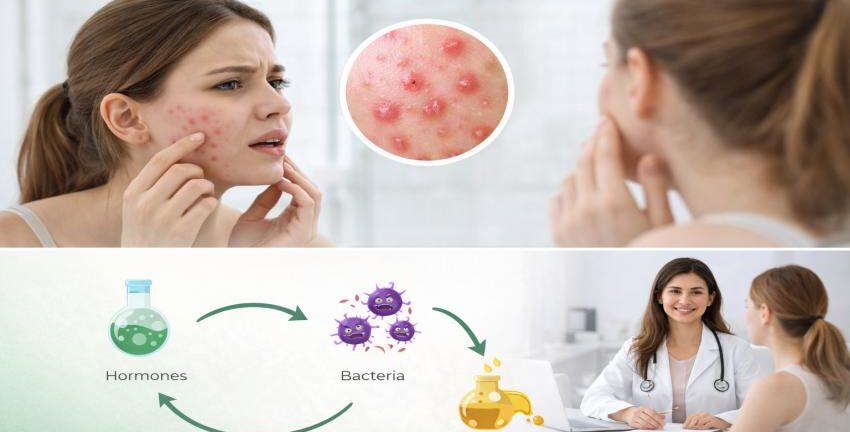
The Endless Struggle with Breakouts:
Acne is often dismissed as a “teenage phase,” but for many adults in Pune, it remains a persistent and distressing reality. You may have tried every “miracle” face wash, followed viral skincare trends, or cut out dairy entirely, yet the breakouts keep coming back, making it important to consult a Skin Specialist in PCMC, Pune.
The frustration of waking up to a new cyst just as an old one starts to fade is exhausting. However, the reason your acne isn’t clearing up usually isn’t a lack of effort—it’s a lack of targeted, medical-grade intervention. Dr. Ruchi Bhirud, with her extensive experience at Clear Skin and Hair MD and specialized training in Aesthetic Dermatology, understands that acne is not a surface-level problem. It is a complex inflammatory disease that requires a multi-dimensional solution.
The Science: Why Acne Happens?
To break the cycle, we must first understand the “Acne Quartet”—the four biological factors that lead to a pimple:
- Excess Sebum Production: Your sebaceous glands produce too much oil, often due to hormonal fluctuations (such as PCOD or high stress).
- Follicular Hyperkeratosis: Dead skin cells don’t shed properly; instead, they “glue” together and clog the pore.
- Bacterial Colonization: A specific bacteria called acnes thrives in the trapped oil, leading to infection.
- Inflammation: Your body’s immune system attacks the bacteria, resulting in the redness, swelling, and pus we recognize as a pimple.
5 Reasons Your Acne is Still Persistent:
1. You Are Self-Medicating with "Spot Treatments":
Most over-the-counter (OTC) creams only treat the “tip of the iceberg.” While a spot treatment might dry out a single pimple, it does nothing to prevent the dozens of microscopic “micro-comedones” currently forming under your skin. Professional care focuses on global prevention, not just local “firefighting.”
2. The "Over-Cleansing" Trap:
Many patients with oily skin believe they need to scrub their face multiple times a day. This is counterproductive. Harsh scrubs and frequent washing damage the skin barrier, leading to “rebound oiliness.” When the skin feels stripped, it signals the glands to produce even more oil to protect itself, worsening the acne cycle.
3. Ignoring the Hormonal Link:
In adult women, acne is frequently tied to hormonal imbalances. If your breakouts are concentrated along the jawline and chin, or if they flare up during your menstrual cycle, topical creams alone will never be enough. Dr. Ruchi Bhirud performs an Accurate Diagnosis to see if internal medical management is required alongside skin treatments.
4. Using the Wrong "Moisturizer" (or None at All):
There is a common myth that acne-prone skin doesn’t need moisturizer. This is false. Dehydrated skin becomes inflamed and brittle. However, using heavy, “comedogenic” (pore-clogging) oils can trigger breakouts. You need medical-grade, non-comedogenic hydration that supports the barrier without suffocating the pores.
5. Post-Inflammatory Hyperpigmentation (PIH) vs. Active Acne:
Sometimes, patients think they have “active acne” when they actually have the dark spots left behind by old pimples. Treating a dark spot with an anti-acne cream is ineffective and can be irritating. Identifying the difference between an active lesion and a scar is the first step in the right treatment plan.
Breaking the Cycle: The Professional Approach
At our clinic in Bavdhan, Dr. Ruchi Bhirud employs a “Step-Ladder” approach to acne management:
- Level: Clinical Medical Management: We prescribe “active” ingredients like Adapalene, Benzoyl Peroxide, or Azelaic Acid in the correct concentrations for your skin type. These work to normalize cell turnover and keep the pores open.
- Level: Chemical Peels for Deep Exfoliation: Salicylic acid is a Beta-Hydroxy Acid (BHA) that is oil-soluble. It travels deep into the pore to dissolve the “glue” holding dead skin cells together. A series of Salicylic or Mandelic Peels can do more for your skin in one session than months of home scrubbing.
- Level: Comedone Extraction: Attempting to “pop” a pimple at home pushes the infection deeper into the dermis, causing a permanent scar. Dr. Ruchi performs sterile, medical extractions of blackheads and whiteheads to clear the skin safely and prevent future inflammation.
Dealing with the Aftermath: Acne Scar Revision
Once the active acne is under control, we address the texture. If the cycle has left you with “pitted” scars, we utilize Acne Scar treatments.
- Microneedling (Dermapen): To trigger the skin’s natural collagen repair.
- Fractional CO2 Laser: To resurface the skin and smooth out deep rolling or boxcar scars.
Dr. Ruchi's Expert Tips for Acne-Prone Skin:
- Keep Your Phone Clean: Your screen carries bacteria that is transferred to your cheeks constantly.
- Pillowcase Hygiene: Change your pillowcase every 2–3 days to avoid sleeping on old oil and bacteria.
- Sunscreen is Mandatory: Many acne medications make your skin sensitive to the sun. Use a gel-based, non-comedogenic sunscreen daily.
- Be Patient: Skin cells take 28 days to renew. You must stick to a clinical regimen for at least 8–12 weeks to see the full transformation.
Conclusion: You Don't Have to Suffer in Silence
Acne is more than skin deep; it affects your social life, your mood, and your self-image. Breaking the cycle requires moving away from “DIY” skincare and trusting a professional who understands the science of the skin.
With the right combination of clinical expertise and patient discipline, clear skin is absolutely achievable.